
Vaughn Woods, MBA, CFP®
President & Founder, Vaughn Woods Financial Group | San Diego, California
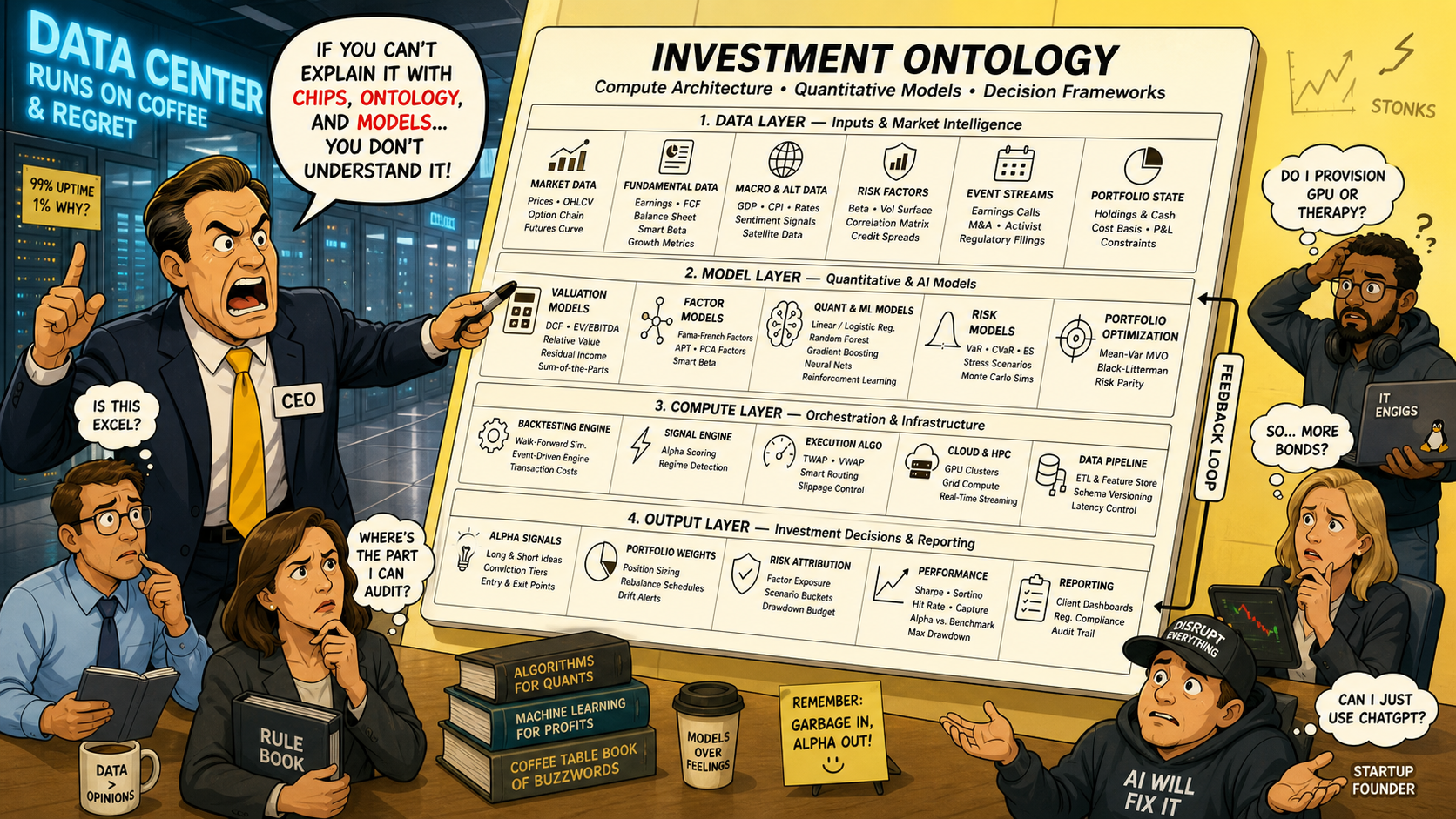
Did anyone else catch Alex Karp going off (again) about chips, ontology, and models? Palantir’s CEO has basically turned “chips + ontology” into his personal drinking game at this point. You can almost see the CNBC host thinking, “We really need a glossary.”
Underneath the rant, though, is a very 2026 reality that’s worth laughing with, not at. Most of us in finance and tech grew up in the “more compute, bigger model” era. If you threw enough GPUs and data at a problem, it felt almost irresponsible to ask whether the system actually understood anything. The mantra was: scale now, understand later.
Karp’s pitch flips that script.
- Compute: the arms race. Everyone’s buying chips.
- Models: increasingly a commodity — more powerful, cheaper to run, and starting to blur together.
- Ontology: his favorite word, the layer that claims to turn “AI slop” into something that actually lines up with how a real business works.
On earnings calls, conferences, and broadcast interviews he keeps coming back to one idea:
“All of the value in the market is going to go to chips and what we call the Ontology. The Ontology allows you to take an LLM, use it, refine it, and impose it on your enterprise.
In plain language:
- Chips are the fuel.
- Models are the engine.
- Ontology is the steering wheel and brakes.
Without the last one, you can go very fast in completely the wrong direction.
What makes this funny (and a little uncomfortable) is how many companies are still selling the engine without the steering wheel. The pitch sounds like: “We’ll drop a frontier model in your environment, and magic will happen.” Karp’s rant is basically: Magic isn’t a risk framework.
On a recent call he put it bluntly:
“The appearance of software working is not software working.”
That line should make every 25–45‑year‑old in this cycle sit up for a second. Because we’re the ones who have to live with the consequences when “AI magic” turns out to be a glorified demo.
He’s drawing a hard line between:
- AI that appears to work vs. AI that actually works in messy environments with regulation, liability, and real‑world consequences.
- Dashboards that make executives feel smart vs. systems that can survive contact with reality.
And he’s doing it loudly enough that you don’t have to.
So what does any of this mean for people who don’t build platforms, but still have to choose vendors, allocate budgets, and explain AI risk to leadership?
A few takeaways worth keeping in your back pocket:
- If a vendor can’t explain how their AI understands your world — not just “the world” — you’re probably buying compute, not capability.
- If the demo looks amazing but no one can articulate where the guardrails come from, you’re probably buying the appearance of outcomes, not.
- If a firm talks more about token counts than business logic, they’re optimizing someone else’s P&L, not yours.
For this generation, the real moat is no longer “we have a big model.” Models are getting cheaper, faster, and more interchangeable. The moat is who can connect those models to actual decision flows — credit, risk, operations, mission planning, compliance — without turning the organization into an expensive hallucination engine.
That’s where ontology and all of its cousins come in.
If the vocabulary is starting to feel like alphabet soup, here’s the quiet truth:
- Semantics, metadata catalogs, knowledge graphs, data graphs, unified semantics, data estate, Fabric, Purview, and Snowflake’s “agent context layer” are all different ways of naming the same underlying idea: a structured layer that tells your systems what your world looks like.
- In other words, they’re all trying to be what Karp keeps calling ontology: a map of entities, relationships, rules, and context that makes AI output actually mean something inside a business instead of just sounding good.
Put simply:
Ontology + AI = meaning making.
That’s the part no vendor can skip if they want to move beyond “talk to your data” demos and into decisions that survive Monday morning.
So the next time you hear someone ranting about chips, ontology, and models, you can smile and translate:
- Chips are table stakes.
- Frontier models are increasingly just the baseline.
- The real action is in the boring, structured layer that knows what a client is, what a position is, what a risk is, and what “don’t do that” looks like in your world.
And if the vocabulary gets overwhelming, you don’t have to memorize every term. You only need to ask better questions:
- “Where does your system get its understanding of our business?”
- “Who maintains that understanding when reality changes?”
- “What’s your plan for steering and brakes, not just fuel and engine?”
In this cycle, the winners won’t be the loudest model vendors. They’ll be the people — and platforms — who quietly connect chips, models, and actual business logic in ways that survive Monday morning.
Karp just happens to be ranting out loud about it so the rest of us don’t have to. That might be the most useful part of the show.
References:
Yahoo Finance. (2026, May 6). Palantir CEO issues blunt warning to “AI slop” competitors.
Palantir Technologies. (2024, June 5). Chips + Ontology | Alex Karp from AIPCon 4
Cheung, S. (2026, June 2). Alex Karp (Palantir CEO)’s favorite word, Ontology
Disclaimer
We are unable to accept orders via email. If you wish to place an order, please consult your registered representative or contact the home office trading desk at (800) 649-4554.
This email system is for business purposes only and any information, including attachments, transmitted in this email is not confidential. Any message may be reviewed by authorized compliance personnel and/or produced to regulatory agencies or others with a legal right to access such information.
Past investment performance is not indicative of future results. Securities offered through Bolton Global Capital, Inc., Bolton, MA. Member FINRA, SIPC. Advisory services offered through Bolton Global Asset Management, a registered investment advisor, 579 Main St., Bolton, MA 01740 (978) 779-5361.
Investors should be aware that there are risks inherent in all investments such as fluctuations in investment principal. Past performance is not a guarantee of future results. Asset allocation cannot assure a profit nor protect against loss. Although the information has been gathered from sources believed to be reliable, it cannot be guaranteed. Views expressed in this newsletter are those of Vaughn Woods and Vaughn Woods Financial Group and may not reflect the views of Bolton Global Capital or Bolton Global Asset Management. The information provided is for general informational purposes only and should not be considered individual recommendation or personalized investment advice. Representatives and Advisors of Vaughn Woods Financial Group are not tax or legal professionals, if you need tax or legal advice, please make sure to consult a tax professional/CPA and/or a lawyer. VW1VWA0391
Recent Blog Posts
- How Investment Advisory Services in San Diego Can Help You Plan for Long-Term Wealth
- Private Wealth Management in La Jolla: Informed Strategies for Long-Term Financial Planning
- How Can Financial Planning for Multi-Generational Wealth Protect Your Family’s Future?
- From Inheritance to Investment: How Successor Trustees Should Manage Trust Assets
- How Can Successor Trustee Financial Guidance in San Diego Help Protect an Estate?