
By Vaughn L. Woods, CFP®, MBA
Founder and Owner, Vaughn Woods Financial Group, Inc.
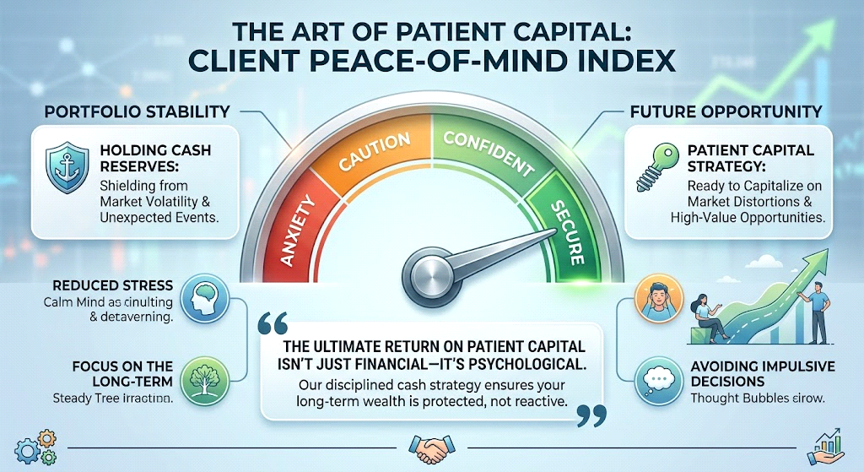
In investing, patience is not passivity. It is strategy. Right now, we are carrying an above-average cash position in your portfolio — and we want you to understand exactly why that decision is deliberate, what it is earning for you today, and what we intend to do the moment the market offers us genuine value. This is not hesitation. This is preparation. And preparation, as history repeatedly confirms, is what separates disciplined investors from reactive ones.
A Rally Built on Narrow Foundations
The current equity rally presents one of the most unusual configurations we have seen in decades. On the surface, the numbers look compelling: mega-cap technology companies have delivered earnings growth that has actually outpaced price appreciation, allowing valuations to compress even as the indices move higher. This is not a classic speculative bubble driven by pure multiple expansion. The earnings are real. The revisions are real. And that matters.
But look beneath the surface, and a more complicated picture emerges. The rally remains characterized by historically narrow breadth — meaning that a very small number of companies are doing the heavy lifting for the entire market (Shiller, 2015). The same leadership cohort, the same systematic flows, and the same momentum dynamics must all continue working simultaneously for this rally to sustain itself. When the engine of a market is this concentrated, a disruption to any one of its moving parts — an earnings miss from a single mega-cap name, a shift in systematic positioning, a reversal in momentum — can produce outsized and rapid dislocations.
Adding to this fragility is what market professionals are calling “nervous bullishness.” Despite equities sitting near all-time highs, intense performance-chasing has left many institutional and individual investors feeling underinvested. They are searching for a catalyst that could disrupt the current momentum regime, and one of the clearest signals of this anxiety is the unusual “spot up, vol up” dynamic seen throughout May 2026 — a configuration where equity prices and volatility rise simultaneously, suggesting that markets are climbing a wall of worry rather than moving with genuine conviction (CFA Institute, 2025). The pain trade, in the near term, likely remains higher. But that does not mean valuations are cheap or that risk has been priced appropriately.
Your Cash Is Not Sitting Idle
Here is the part of this story we want you to hear clearly: the cash we are holding for you is not sitting on the sidelines — it is actively earning a meaningful, competitive return right now. In today’s interest rate environment, high-quality cash vehicles are generating yields that have not been broadly available to investors in many years (Federal Reserve, 2026).
Even Warren Buffett’s Berkshire Hathaway — holding an enormous reserve in cash and short-term U.S. Treasuries — has publicly embraced this posture, earning a solid return on those reserves while patiently waiting for the right opportunity to deploy capital at the right price. In an environment where the equity market carries elevated concentration risk and momentum dependency, earning a competitive yield on your dry powder is not a sacrifice. It is a return.
We are not asking you to wait for nothing. We are asking you to be compensated while we wait for value.
Two Stories That Put This in Perspective
The Patient Investor of 2007–2009. In the years leading up to the financial crisis, many prudent investors who recognized frothy valuations and concentrated risk quietly raised their cash allocations. While their peers were fully invested chasing the final legs of a bull market, they were building dry powder. When Lehman Brothers collapsed in September 2008 and the S&P 500 ultimately fell more than half its value, those investors were not paralyzed — they were positioned (Shiller, 2015). Warren Buffett himself deployed capital into major financial institutions on negotiated terms that ordinary investors could only dream of. His competitive advantage was not foresight alone. It was liquidity. The lesson is timeless: the best time to have cash is when everyone else has none.
The Thirty-Three Days of March 2020. In just 33 trading days, the S&P 500 fell sharply as COVID-19 shuttered the global economy. Fear was universal. Selling was indiscriminate. But investors who had maintained even a modest above-average cash allocation were able to rebalance into high-quality equities near the lows rather than selling into them (Siegel, 2021). What followed was one of the fastest and most powerful recoveries in market history. Those who were fully invested at the peak had to wait years to recover. Those with dry powder had one of the great buying opportunities of a generation. The difference between these two outcomes was not intelligence or luck. It was preparation.
Five Implications for Your Portfolio Today
You are being compensated to wait. Your cash is not a drag — it is an actively earning, low-risk component of your total return at a time when equity risk remains elevated (Federal Reserve, 2026).
Concentration risk is real and rising. The current rally’s dependence on a handful of mega-cap technology leaders means the index offers far less diversification than it appears. A single earnings disappointment or regulatory shock to one of these names could cascade through the entire market. Cash insulates you from that tail risk (Damodaran, 2024).
Momentum regimes end without warning. The systematic flows and performance-chasing that have fueled this rally can reverse quickly. When they do, liquidity becomes scarce precisely when it is most needed. We intend to have yours available.
Tariff and geopolitical uncertainty may create sector dislocations. Trade policy under the current administration continues to reshape global supply chains and corporate margins. These dislocations will eventually create pockets of genuine undervaluation in specific sectors and geographies — opportunities that require capital to exploit. We will be ready (CFA Institute, 2025).
Valuation discipline is the foundation of long-term wealth. Overpaying for assets at peak momentum and elevated concentration levels is one of the most reliable paths to below-average long-term returns. We are not in the business of chasing. We are in the business of compounding — and compounding begins with buying at the right price (Shiller, 2015).
We Will Strike When the Market Gives Us Value
Our above-average cash position is not a permanent posture. It is a tactical one — built on the recognition that the current environment rewards patience and punishes impulsivity. The moment the market presents us with genuine value — through a meaningful correction, a sector dislocation, a rotation away from the current momentum cohort, or a macro shock that separates price from intrinsic worth — we will act decisively and deploy capital on your behalf.
We are not waiting for certainty. Markets never offer certainty. We are waiting for price. And when price aligns with value, we will move with conviction.
In the meantime, your capital is protected, productive, and positioned. That is exactly where it should be.
Let’s Talk — and Bring Someone You Trust
If this perspective resonates with you, we would welcome a conversation. Whether you have questions about your current allocation, want a deeper review of how your portfolio is positioned for what comes next, or simply want to talk through the landscape, we are always available.
And if you know someone — a family member, a trusted colleague, a friend navigating a financial transition — who would benefit from this kind of disciplined, patient, fiduciary approach to wealth management, we would be honored to be introduced. The greatest compliment our clients can pay us is the confidence of a referral. We treat every relationship with the same care and commitment we have brought to yours.
To schedule a conversation, contact us at 858-454-6900 or vw@vaughnwoods.com. We look forward to hearing from you.
References
Damodaran, A. (2024). The little book of valuation: How to value a company, pick a stock and profit (2nd ed.). Wiley.
Shiller, R. J. (2015). Irrational exuberance (3rd ed.). Princeton University Press.
Siegel, J. J. (2021). Stocks for the long run: The definitive guide to financial market returns and long-term investment strategies (6th ed.). McGraw-Hill Education.
Disclosures
We are unable to accept orders via email. If you wish to place an order, please consult your registered representative or contact the home office trading desk at (800) 649-4554.
This email system is for business purposes only and any information, including attachments, transmitted in this email is not confidential. Any message may be reviewed by authorized compliance personnel and/or produced to regulatory agencies or others with a legal right to access such information.
Past investment performance is not indicative of future results. Securities offered through Bolton Global Capital, Inc., Bolton, MA. Member FINRA, SIPC. Advisory services offered through Bolton Global Asset Management, a registered investment advisor, 579 Main St., Bolton, MA 01740 (978) 779-5361.
Investors should be aware that there are risks inherent in all investments such as fluctuations in investment principal. Past performance is not a guarantee of future results. Asset allocation cannot assure a profit nor protect against loss. Although the information has been gathered from sources believed to be reliable, it cannot be guaranteed. Views expressed in this newsletter are those of Vaughn Woods and Vaughn Woods Financial Group and may not reflect the views of Bolton Global Capital or Bolton Global Asset Management. The information provided is for general informational purposes only and should not be considered individual recommendation or personalized investment advice. Representatives and Advisors of Vaughn Woods Financial Group are not tax or legal professionals, if you need tax or legal advice, please make sure to consult a tax professional/CPA and/or a lawyer. VW1/VWA0378
Recent Blog Posts
- How Investment Advisory Services in San Diego Can Help You Plan for Long-Term Wealth
- Private Wealth Management in La Jolla: Informed Strategies for Long-Term Financial Planning
- How Can Financial Planning for Multi-Generational Wealth Protect Your Family’s Future?
- From Inheritance to Investment: How Successor Trustees Should Manage Trust Assets
- How Can Successor Trustee Financial Guidance in San Diego Help Protect an Estate?