
Vaughn Woods | November 16, 2026
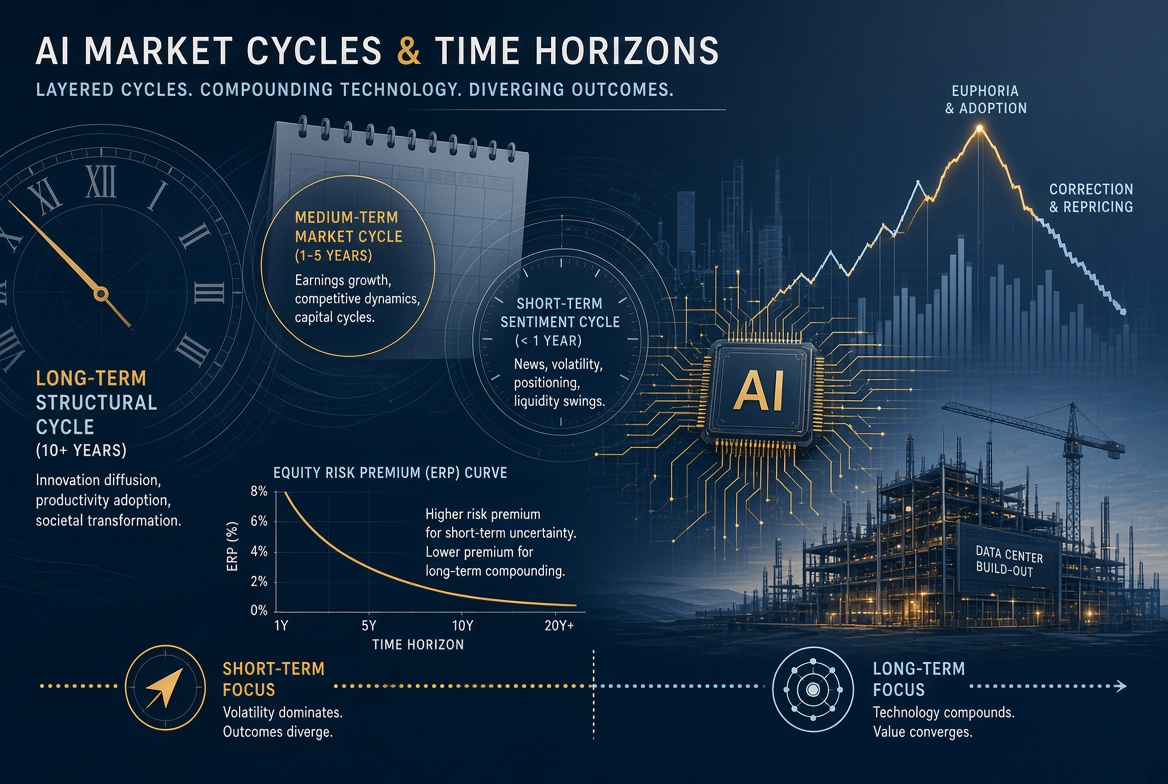
The recent reversal in AI-related equities has produced two seemingly incompatible narratives. One side argues that the decline has not yet run its course and that further estimate cuts lie ahead. The other, including voices such as Nouriel Roubini, suggests the slowdown may ultimately prove constructive: sustained demand combined with greater regulatory scrutiny and a more lawyered-up political environment can stretch the expansion, dampen classic boom-bust amplitude, and lengthen the overall economic cycle. Both readings can coexist because they are not talking about the same interval of time. Days, months, a couple of years, and multi-year diffusion are four different conversations that happen to use the same ticker symbols.
Over the coming year the base case remains range-bound to softer trading in the highest-beta infrastructure cohort. Hedge-fund and systematic positioning has already lightened materially, which creates the mechanical possibility of squeezes around major earnings prints or large capital-markets events. Those rallies, however, face a higher bar for follow-through while credit markets continue to demand wider spreads for AI-related issuance and while hyperscaler spending growth decelerates from its earlier pace. By the second year the locked-in portion of the data-center pipeline should begin to translate into recognizable revenue, supporting a relative recovery even if absolute multiples do not return to prior peaks. The broader market can still advance if leadership rotates away from pure infrastructure toward application and productivity beneficiaries.
Five distinct time models operate at once:
- The shortest clock is measured in days and weeks and is governed almost entirely by positioning, dealer gamma, and short covering. Extreme underweights make violent upside possible; the same model loses its edge the moment the covering is complete.
- The next clock runs across earnings seasons and is measured in months. Each major print forces analysts to reconcile published growth rates with what the market has already capitalized. When prices embed far more caution than the sell-side consensus, this model expects the forecasts to migrate toward the tape.
- The capital-expenditure and financing clock spans one to several years. It asks who ultimately funds the incremental spend once internal cash generation no longer covers the outlays and once traditional high-yield buyers have stepped back. Existing construction already in the ground limits the near-term cancellation risk, yet new mega-commitments become harder to assemble.
- The adoption and productivity clock is the classic S-curve measured across multiple years. Real economic surplus appears only after models shift from training to widespread inference and after enterprises reorganize workflows around the new capability. This horizon is largely indifferent to intermediate multiple compression.
- The regulatory and political clock follows electoral and legislative cycles. Incoming majorities inclined to emphasize antitrust, export controls, energy permitting, and local siting rules can slow the pace of deployment. Roubini-style observers treat that friction as cycle-extending rather than cycle-ending: a more measured build reduces the probability of a sharp bust and thereby supports a longer expansion.
Each camp sees itself as correct for reasons internal to its chosen horizon. Positioning-focused participants note that systematic and discretionary investors have already reduced exposure to levels that historically precede mean-reverting bounces. Valuation-oriented participants observe that current prices already discount growth rates well below published consensus, and that forecasts have a long record of eventually following price. Cycle-extenders point to the volume of capacity already under construction, to persistent enterprise interest in practical applications, and to the political preference for regulated rather than explosive growth.
Each camp can also be wrong for equally coherent reasons. The positioning trade fails if the marginal buyer never materializes because credit markets remain restrictive. The estimate-revision trade fails if completions of projects already financed exceed even conservative pipeline assumptions and continue to fund further investment. The regulation-as-stabilizer thesis fails if permitting delays and higher borrowing costs simply cancel projects rather than stretch them, producing an earlier peak in the contribution of AI spending to aggregate earnings growth.
Three earlier technology cycles display the same sequence of multiple expansion, subsequent de-rating, and adjustment in equity risk premia while the underlying innovation continued to diffuse. In the late-1990s internet infrastructure wave, capital expenditure and valuations rose together until growth rates inevitably slowed; equity risk premia then expanded sharply and prices corrected severely even as the technology itself kept permeating commerce and daily life. During the subsequent cloud and mobile transition, earnings growth accelerated for an extended period before moderating; risk premia compressed while free-cash-flow conversion improved and then stabilized once the market accepted a more mature growth profile. Earlier semiconductor up-cycles linked to successive waves of consumer electronics showed relative valuations peaking well before unit volumes; a subsequent interval of underperformance followed while capacity and inventory rebalanced, accompanied by a modest rise in required risk premia. In each instance the innovative cycle generated lasting economic value, yet equity markets re-priced the growth rate and the risk premium on a shorter clock than the technology itself required.
The practical implication is straightforward: an investor must declare the relevant horizon before declaring a directional view. A desk operating on the shortest clock can be tactically long the same names that a two-year fundamental allocator continues to underweight. Both can be directionally accurate inside their own frames. The economy and the AI build-out will proceed; the open variables are only the slope of that build-out, the cost of the capital that finances it, and the degree to which political and regulatory friction elongates or truncates the path.
Call to Action
If the constant noise around AI, rates, and markets has left you unsure how to position for your own goals—or if you simply want a real person who will pick up the phone, answer questions, and adjust the portfolio as your life and family circumstances change—then consider Vaughn Woods Financial Group, Inc. I am the senior portfolio manager. With four decades of experience I work directly with clients in an ongoing dialogue so that the portfolio can reflect your specific situation rather than a standardized approach. Call 1-800-374-4412 if you want portfolio management treated as a personal responsibility.
Sources
Coppersmith, L. (2026, November). US equities—AI confidence is fading. Goldman Sachs Prime Services.
Durden, T. (2026, November 16). Has the AI selloff gone too far, or is Wall Street front-running estimate cuts? ZeroHedge. zerohedge.com
NVIDIA Corporation. (2026). Quarterly report on Form 10-Q. U.S. Securities and Exchange Commission.
Roubini, N. (2025–2026). Commentary on AI regulation, demand persistence, and cycle length. Project Syndicate and Roubini Macro Associates.
Bernstein Research. (2026). Assessment of announced versus credible U.S. data-center capacity.
Bank for International Settlements & Federal Reserve research notes. (2025–2026). AI-related investment, credit conditions, and contributions to growth.
Disclaimer
Disclaimer
We are unable to accept orders via email. If you wish to place an order, please consult your registered representative or contact the home office trading desk at (800) 649-4554.
This email system is for business purposes only and any information, including attachments, transmitted in this email is not confidential. Any message may be reviewed by authorized compliance personnel and/or produced to regulatory agencies or others with a legal right to access such information.
Past investment performance is not indicative of future results. Securities offered through Bolton Global Capital, Inc., Bolton, MA. Member FINRA, SIPC. Advisory services offered through Bolton Global Asset Management, a registered investment advisor, 579 Main St., Bolton, MA 01740 (978) 779-5361.
Investors should be aware that there are risks inherent in all investments such as fluctuations in investment principal. Past performance is not a guarantee of future results. Asset allocation cannot assure a profit nor protect against loss. Although the information has been gathered from sources believed to be reliable, it cannot be guaranteed. Views expressed in this newsletter are those of Vaughn Woods and Vaughn Woods Financial Group and may not reflect the views of Bolton Global Capital or Bolton Global Asset Management. The information provided is for general informational purposes only and should not be considered individual recommendation or personalized investment advice. Representatives and Advisors of Vaughn Woods Financial Group are not tax or legal professionals, if you need tax or legal advice, please make sure to consult a tax professional/CPA and/or a lawyer.VW1/VWA0443
Recent Blog Posts
- AI Selloff or Cycle Extension? Five Time Models That Let Everyone Be Right
- The Successor Trustee’s Playbook: Managing a Trust After a Loved One Dies
- How Investment Advisory Services in San Diego Can Help You Plan for Long-Term Wealth
- Private Wealth Management in La Jolla: Informed Strategies for Long-Term Financial Planning
- How Can Financial Planning for Multi-Generational Wealth Protect Your Family’s Future?