By Vaughn Woods, Senior Portfolio Manager | Author | November 18, 2026
When prices rise too fast, the Federal Reserve steps in like a driver tapping the brakes on a speeding car. By raising interest rates, the Fed makes it more expensive to borrow money for cars, credit cards, and business loans. The goal is simple: cool down spending so prices stop climbing. While tapping the brakes helps prevent an economic crash, slowing the economy alone cannot fix all of our financial problems. In fact, pushing that brake pedal too hard creates brand-new headaches for everyday families, homebuyers, and the U.S. government.
The Good News About Tapping the Brakes
First, it helps to see why the Fed uses this tool at all. When too many dollars chase too few goods, businesses raise prices and workers ask for bigger paychecks to keep up. By lifting its benchmark interest rate into the 3.75% to 4.00% range—and signaling more small increases if needed—the Fed encourages people to save rather than spend. This cools off what economists call the “wealth effect,” where rising stock portfolios make wealthy shoppers spend freely on travel and luxury goods. Lowering that demand helps bring annual inflation back down toward the Fed’s 2% comfort zone.
Four Reasons Slowing Growth Falls Short
Even though cooling demand is a smart first step, relying on a slower economy as the only cure leaves four major problems unsolved:
- Interest Rates Cannot Fix Supply Shortages: Higher borrowing costs cool down shopping, but they cannot pump more crude oil out of the ground, erase import tariffs, or speed up delivery trucks. When energy prices spike or global shipping gets tangled, producer prices can surge above 6% even while regular families cut back. If the economy slows down while supply shortages keep prices high, we risk “stagflation”—a painful mix of slow growth and stubbornly high bills.
- Policy Moves in Slow Motion: Fed rate hikes do not work overnight. Economists call this “long and variable lags,” meaning it often takes 12 to 18 months for a rate hike to fully ripple through stores and workplaces. Because policymakers are essentially driving while looking in the rearview mirror, they risk pressing the brakes too hard. Out of 11 major Fed rate-hiking cycles since 1965, most ended in a recession rather than a gentle “soft landing.”
- The Housing Affordability Trap: You might think slowing the economy would make buying a home cheaper, but high rates actually freeze the housing market. With 30-year fixed mortgage rates hovering above 7%, millions of current homeowners refuse to sell because they do not want to give up their older, lower-rate loans. At the same time, high financing costs discourage builders from starting new neighborhoods. Restricting new construction today creates a deeper housing shortage tomorrow, which pushes rents and home prices right back up the moment interest rates finally drop.
- The Federal Debt Catch-22: Today, the U.S. national debt tops $40 trillion, and the government spends roughly $1.1 trillion a year just on interest payments—more than the entire national defense budget. Roughly $7 trillion of that debt matures and must be refinanced every year at current rates. If the Fed slows the economy too much, tax collections from paychecks, corporate profits, and stock market gains shrink. That forces the Treasury to borrow even more money to cover annual deficits near $2 trillion, canceling out the benefit of lower bond yields.
What We Really Need Alongside a Slower Economy
To truly lower inflation, unlock affordable housing, and manage our national debt without hurting working families, a gentle economic slowdown must be paired with supply-side growth:
- Smarter Productivity: When businesses use new technology—such as artificial intelligence and modern automation—to produce more goods in less time, companies can pay workers well without raising prices on customers.
- More Supply, Fewer Bottlenecks: Building more starter homes, expanding reliable energy production, and cutting red tape help bring prices down naturally from the supply side.
- Steady Government Budgets: Keeping federal deficits from growing faster than the economy ensures the government does not flood the bond market and keep interest rates artificially high.
The Takeaway
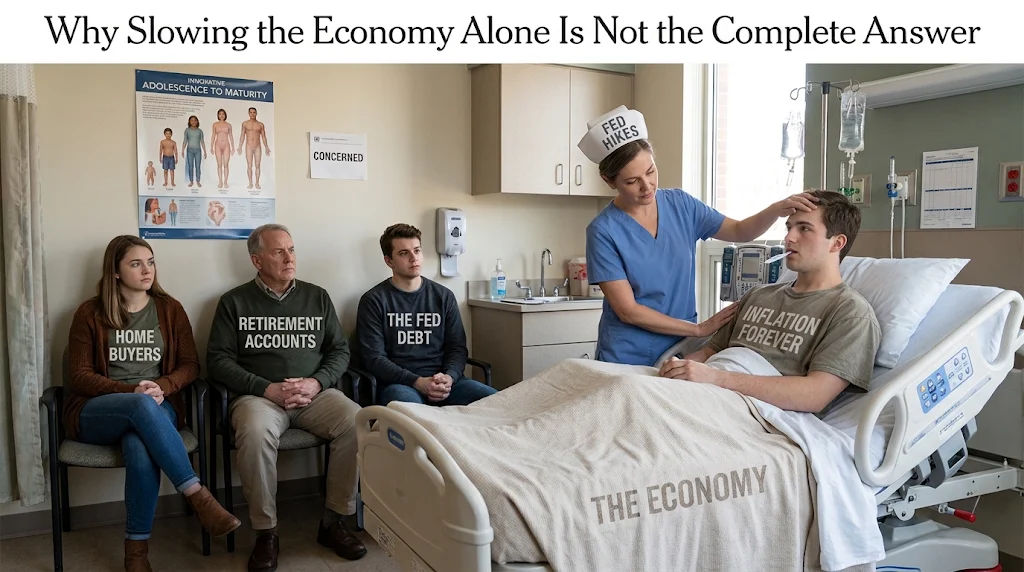
Think of slowing the economy like taking medicine to bring down a fever. It keeps a dangerous situation from getting worse and buys the body time to heal. Yet medicine alone does not build strength. Lasting economic health comes from pairing careful Fed policy with higher worker productivity, stronger housing supply, and responsible government spending—giving families a steady path forward without stalling the engine of opportunity.
Sources
Board of Governors of the Federal Reserve System. (2026, October 28). Federal Reserve issues FOMC statement. https://www.federalreserve.gov/newsevents/pressreleases/monetary20261028a.htm
Committee for a Responsible Federal Budget. (2026, August 20). Treasury confirms $1.8 trillion deficit for first 10 months of FY 2026. https://www.crfb.org/blogs/treasury-confirms-18-trillion-deficit-first-10-months-fy-2026
Freddie Mac. (2026, November 12). Primary mortgage market survey: 30-year fixed-rate mortgages. https://www.freddiemac.com/pmms
Peterson Foundation. (2026, August). Interest costs on the national debt. https://www.pgpf.org/analysis/2026/08/interest-costs-on-the-national-debt
U.S. Department of the Treasury. (2026, November 5). Interest expense on the debt outstanding. https://fiscaldata.treasury.gov/datasets/interest-expense-outstanding/interest-expense-on-the-public-debt-outstanding
Disclaimer
We are unable to accept orders via email. If you wish to place an order, please consult your registered representative or contact the home office trading desk at (800) 649-4554.
This email system is for business purposes only and any information, including attachments, transmitted in this email is not confidential. Any message may be reviewed by authorized compliance personnel and/or produced to regulatory agencies or others with a legal right to access such information.
Past investment performance is not indicative of future results. Securities offered through Bolton Global Capital, Inc., Bolton, MA. Member FINRA, SIPC. Advisory services offered through Bolton Global Asset Management, a registered investment advisor, 579 Main St., Bolton, MA 01740 (978) 779-5361.
Investors should be aware that there are risks inherent in all investments such as fluctuations in investment principal. Past performance is not a guarantee of future results. Asset allocation cannot assure a profit nor protect against loss. Although the information has been gathered from sources believed to be reliable, it cannot be guaranteed. Views expressed in this newsletter are those of Vaughn Woods and Vaughn Woods Financial Group and may not reflect the views of Bolton Global Capital or Bolton Global Asset Management. The information provided is for general informational purposes only and should not be considered individual recommendation or personalized investment advice. Representatives and Advisors of Vaughn Woods Financial Group are not tax or legal professionals, if you need tax or legal advice, please make sure to consult a tax professional/CPA and/or a lawyer.VW1/VWA0444
Recent Blog Posts
- Why Slowing the Economy Alone Is Not the Complete Answer
- AI Selloff or Cycle Extension? Five Time Models That Let Everyone Be Right
- The Successor Trustee’s Playbook: Managing a Trust After a Loved One Dies
- How Investment Advisory Services in San Diego Can Help You Plan for Long-Term Wealth
- Private Wealth Management in La Jolla: Informed Strategies for Long-Term Financial Planning